
Indigo: A Dye, A Tradition, A Relationship with Land
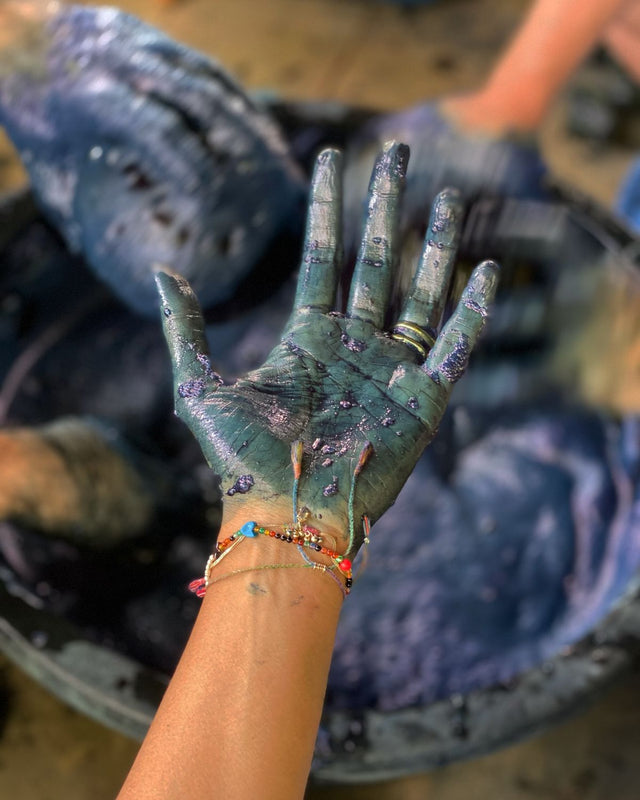
Before synthetic dyes existed, color came from the earth directly. Plants, minerals, and soil gave cloth its hue, and the range of colors available to any community was shaped by what grew nearby. Among all of these, indigo occupies a particular place. For thousands of years, across Asia, Africa, and the Americas, people found ways to draw a deep, lasting blue from the leaves of the Indigofera plant. It is one of the oldest known dyes, and one of the few natural dyes that bonds directly with fiber rather than sitting on its surface.
That difference matters. Synthetic dyes coat the outside of a thread. Natural indigo undergoes a chemical process within the fiber itself, which is why indigo-dyed cloth develops over time, deepening or softening with wear and washing in ways that are specific to each piece. The color is not fixed. It continues to respond to use, to light, to the body that wears it.
How Indigo Works

Producing indigo dye is not a simple extraction. The leaves of the Indigofera plant contain a compound called indican, which has no color on its own. To release the dye, the leaves must be fermented in water, a process that requires time, observation, and an understanding of how temperature and oxygen affect the chemistry of the vat.
Once the dye is ready, cloth is submerged and then lifted into the air. The exposure to oxygen is what turns the fiber blue: the dye oxidizes on contact with air, shifting from yellow-green to the blue that is visible in the finished cloth. Each dip adds depth. Many of the pieces in our collections are dipped multiple times, building color slowly and deliberately.
This is a process that cannot be rushed. It asks the person working with it to pay attention, to read the vat, and to adjust. The knowledge involved is accumulated over years. It is one of the reasons we describe our relationship with the artisans who do this work as one of learning rather than simply sourcing.
Indigo in Indonesia
Indigofera has been cultivated and used across the Indonesian archipelago for centuries. It appears in batik traditions, in ikat weaving, and in the textile histories of regions from Java to East Nusa Tenggara, where natural dyes remain part of living craft practice even as synthetic alternatives have made inroads.

The indigo we use at Sejauh Mata Memandang comes from Temanggung, Central Java, through our collaboration with Shibiru, founded by Fatah Syaifur Rochman. Shibiru works with a network of around 179 farmers who grow Strobilanthes cusia, a variety of indigo plant native to South and Southeast Asia, intercropped beneath coffee and guava trees. The harvested plants are fermented without chemical additives and processed into paste and powder. The production waste returns to the soil as organic fertilizer.
This is what a circular material practice looks like at the source: the plant gives back to the land it grew in, and the knowledge of how to cultivate and process it is held by a community rather than a single producer.
What the Plant Gives Back
Indigofera is a nitrogen-fixing plant, which means its root system draws nitrogen from the air and deposits it in the soil. Growing indigo improves the land it occupies rather than depleting it. This is not a marginal detail. In an industry where agricultural inputs for fiber crops often degrade soil health over time, a crop that enriches what it grows in is worth paying attention to.

The indigo from Shibiru has shaped several of our collections directly. The Tarum collection, which includes Muara, was built around plant-based dye as a central material decision, with yarn dyed through repeated hand-dipping using water recycled across each stage of the dyeing and washing process. The Rimba and Puspa collections also draw on indigo, processed through the hands of artisans at Mugi Batik and Craft Denim in Pekalongan.
In each case, the color in the finished cloth carries a traceable origin: a plant grown in a specific place, by specific people, processed without synthetic chemistry, and applied through a technique that has been refined over generations.
Why This Matters to Us

We use indigo because it is one of the most honest dyes available to us. Its process is visible and traceable. Its relationship with the land is restorative rather than extractive. The knowledge required to work with it well belongs to communities who have tended that knowledge over time, and our role is to support and learn from those communities, not simply to source from them.
Color is often understood as a surface quality, something added to cloth after the fact. Indigo asks for a different understanding. The blue in a piece dyed with natural indigo is the result of chemistry, time, specific plants grown in specific soil, and the accumulated skill of the people who worked with it. That history is present in the cloth itself, even if it is not immediately visible.
We find that a reason to keep working with it, and a reason to keep asking questions about where color comes from.
Every day is Earth Day.



0 Comments
There are no comments for this article. Be the first one to leave a message!