
Studio Sejauh: Weaving as a Way of Knowing, A Dialogue with Nazif Lopulissa
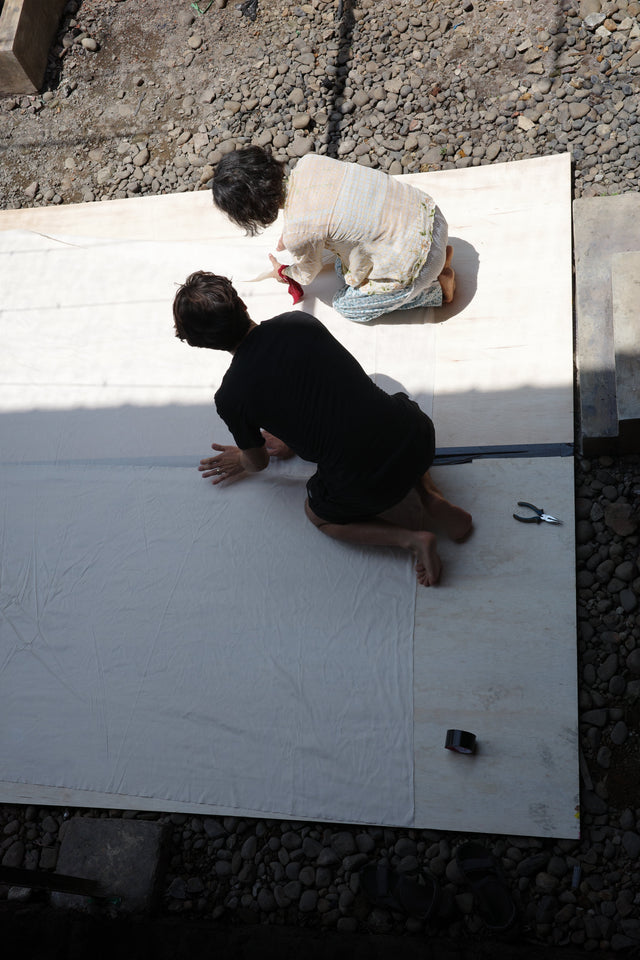

When we hear the word decolonization, we tend to reach for something large: a political reckoning, a historical process, a structural shift that happens at a scale beyond the everyday. But decolonization also lives in smaller gestures. In the way a hand ties a knot before the dye touches the thread. In the decision to name every person who contributed to a work, rather than letting them disappear behind the finished object. In the choice to treat craft not as a lesser form of knowledge, but as knowledge itself.

This is where the collaboration between Studio Sejauh and Nazif Lopulissa began, and where it kept returning, across ten days in October 2025 at Craft Denim in Pekalongan, with the support of artisans from Mugi Batik. The works that emerged from that residency were later shown at Erasmus Huis, Jakarta, as part of the State of Fashion programme Perspectives On... Weaving Threads, running from November 1 to December 24, 2025.
A Seed, Not a Slogan

Nazif is a visual artist whose practice is rooted in the Moluccan diaspora, in the intergenerational histories that the first and second generations chose not to speak about, and that he has chosen to carry into the open. "Decolonization in my practice does not emerge as a slogan," he says, "but as a seed that keeps growing." That seed, for him, was planted seventy-five years ago, when the Moluccan people were forced to migrate to the Netherlands, carrying a trauma that was passed down without being named.

Arriving in Pekalongan, he brought that history with him, and found it already present in the cloth. The batik buketan tradition, with its hand-drawn floral motifs, carries its own layered colonial inheritance. The style was popularized in the late nineteenth century by Dutch designer Eliza van Zuylen, who worked with two Chinese artisans whose draftsmanship was exceptional. Their technique was gradually adopted by local batik makers, producing a visual language shaped by colonial circulation, migration, and unequal relations of power, but continuously reinterpreted by the hands that kept making it. The history is in the pattern. It was never resolved. It was simply carried forward, stitch by stitch.
Clove as Gesture

Some of the works produced during the residency use white cotton dyed with clove and fixed with iron. The choice of clove was not incidental. It was once the center of colonial extraction in the archipelago, a spice that drove trade routes, displacement, and violence across centuries. Here, it becomes something different: a dye, a scent, a material that returns to the body as care rather than commodity.
"Decolonizing the way of buying means going back to the idea of what you want to tell," Nazif reflects. "From there, the palette of working takes shape." In this case, the story is clove, natural materials, and the quality that allows each piece to stand on its own, outside the logic of mass production. "Each work has a different fabric, and each fabric has its own character. I try to embrace that character and use it to create an identical touch."
The ikat process itself carries this logic further. Thread is bound before it meets the dye, each knot holding back light while the rest absorbs color. When released and woven, the pattern that emerges is never entirely predictable, always the result of a balance between the hand and what the material decides to do. It is a process that asks the maker to be present without being in full control.
Working Without Gatekeeping

One of the things Nazif observed most clearly in Studio Sejauh's way of working was its openness. "The innovative approach of Sejauh is that they work directly with local people and go straight to the source. They try not to gatekeep their craftsmen, but instead expose them so everybody can work with them."
This is something he carried into the work itself. At the exhibition, a QR code accompanies each piece, documenting everyone who contributed: who they are, what they did, and how they did it. The transparency is not performative. It is structural. It insists that the work belongs to everyone who made it, and that making something together means saying so.
For Nazif, this ten-day process was unlike anything he had done before. "I usually try to solve problems alone," he says, "but now, because everyone was working together to make it happen in ten days, it felt very different. Normally, I could spend ten days just reading, reflecting, and sketching before starting anything. But with this project, overthinking was not possible. And because overthinking was not possible, the playfulness started again."
Craft as Living Knowledge

There is a question embedded in this collaboration that Studio Sejauh has long been sitting with: why is textile craft still understood as something lesser than fine art, when the knowledge it carries has been evolving for centuries?
"The textile itself, in a Western perspective, is often read as craft," Nazif observes. "But it existed way before contemporary painting was even a thing. So why should we still see it as mere craft? Is it because the heritage is so deep that it has become normalized, something we take for granted, while in fact it protects and takes care of us?"
For Studio Sejauh, this is not an abstract question. It shapes how we work with Keluarga Sejauh, how we speak about the artisans who make our cloth, and how we understand the loom as a space of accumulated knowledge rather than simply a production tool. Weaving is not preservation. It is renewal. A conversation between what has been learned and what is still being discovered.
What Remains

Nazif hopes this collaboration is the beginning of something longer. "I hope this will be a durable relationship," he says simply. "Like friends forever."
That quality of friendship, of working side by side without hierarchy, of learning from each other rather than from a distance, is what this collaboration was built on. Decolonization, practiced this way, does not arrive and announce itself. It grows in the space between people who choose to make something together, honestly, and remember who was in the room.
Every day is Earth Day.



0 Comments
There are no comments for this article. Be the first one to leave a message!