
Three Hundred Times, A Dialogue with Dino Augusto
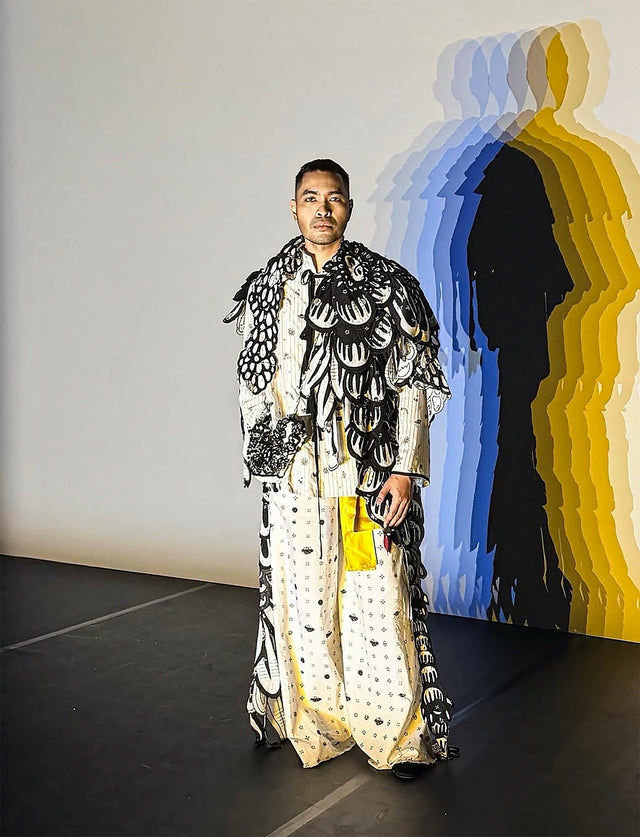
There is a particular tension in Dino Augusto's work that he names without hesitation. He teaches at LaSalle College Jakarta, training students who will one day produce and market fashion in Indonesia. He also co-hosts Meja Bundar, a YouTube podcast that asks harder questions about what that industry actually costs.
These two things sit together in the same room every week.
Before students in his classroom can think about circular practice or responsible production, Dino starts somewhere more uncomfortable: with them. Their own habits. The ease of the impulse buy. The comfort of the throwaway. He calls this teaching consumer psychology first, and everything else follows from there. Not because the industry comes second, but because without understanding how you were shaped as a consumer, the larger picture rarely lands.

"It is a privilege," he says, "to be able to understand these things." He means it plainly, not as a compliment. Conscious practice in fashion requires access to education, to time, to information that is not designed to reach everyone. His students have that access. The question is what they do with it.
The Price Wall
One of the gaps Dino keeps returning to is price literacy. People get frustrated when a piece of clothing feels expensive. They almost never ask why something can be sold so cheaply in the first place.
This is not a problem specific to young consumers, though he sees it sharply in the middle market, where price sensitivity runs high and the structures behind pricing stay invisible. The cost of materials, the hours of labor, the margins that allow a maker to keep working; these are not part of the public conversation about clothing. What circulates instead are hauls and reactions. The wearing, the styling.

"Most content creators focus on how the clothing looks," he says. "Rarely on how the industry actually works or what it costs." Influencers are not the problem in themselves. The problem is the gap between what gets amplified and what gets left out. Taste has always been shaped by what we are shown. When the industry stays offscreen, the choices people make reflect that absence.
Dino does not ask his students to reject the systems they grew up inside. He asks them to understand where those systems came from, and to be honest about what they cannot see from where they are standing.
A Structural Problem
The clothing industry in Indonesia runs on roughly ninety percent imported materials. Even what gets exported is largely assembled from what was first brought in. This is not a recent failure. It is a structural one, built over decades of prioritizing the speed of import over the slower work of developing local capacity.

Labels like Sejauh Mata Memandang represent something alongside this: a deliberate attempt to build a smaller, more rooted system. Local fiber sourcing, artisan partnerships, a circular practice that treats clothing as something worth keeping. Dino describes this as feeding a new system, even while the old one continues around it.
That phrase carries the weight of what he teaches. Change in the industry does not come from dismantling what exists. It comes from building something alongside it that can eventually hold more weight.
What the Classroom Is Becoming
Something has shifted in recent years. Dino notices it in the research his students bring in, in the directions their final projects take. Heritage. Transparency. The long life of a material. These are not assigned themes. They are where students are choosing to go.
The classroom works, he says, because it is grounded in research and institutional data rather than opinion. When a student challenges an idea, they do it with evidence. When he responds, so does he. This is what separates the conversation in a lecture hall from the one happening in comment sections. Not the topic, but the ground it stands on.

His podcast following is approaching six hundred thousand. People write to tell him they changed how they shop. Some came to a screening he organized and left thinking differently. The process is slow. He is clear about that. It takes years for someone to genuinely internalize what responsible practice in fashion means. There is no shortcut, and he is not looking for one.
The One Question
When asked what single question he would want every student to carry into a shop with them, Dino does not pause.
"Are you really going to wear that piece three hundred times?"

Not as a rule. Not as a test to pass. As something to sit with honestly before deciding. Three hundred wears means a relationship with an object, a reason to choose it carefully, a willingness to care for it over years rather than seasons.
That relationship, quiet and ordinary as it sounds, might be where the work actually begins.



0 Comments
There are no comments for this article. Be the first one to leave a message!