
Studio Sejauh: Made to Last, Side by Side with KAIT Handmade
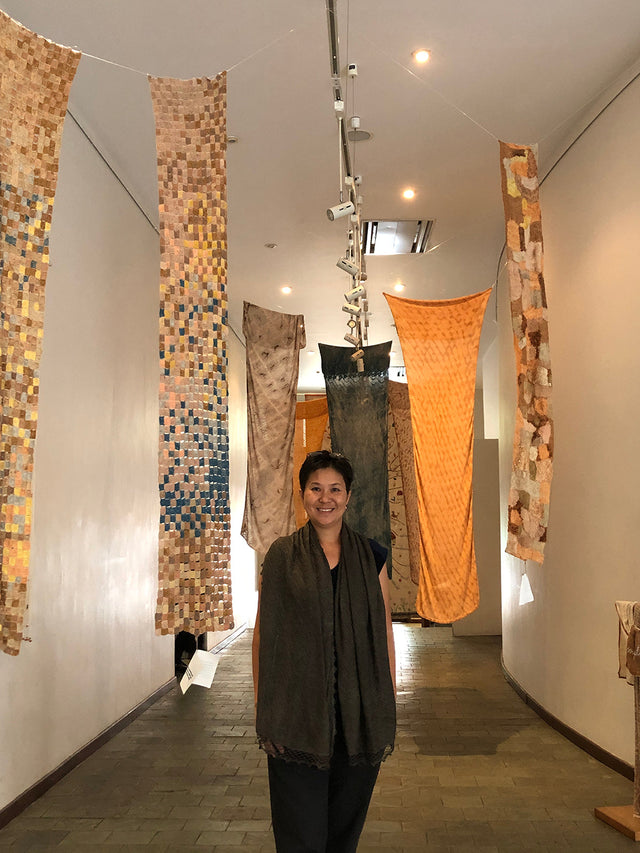
Lusiana Limono returned to Malang in the early 2010s not because she had run out of ideas, but because she had run out of patience with a certain kind of pace.
She had spent years in Jakarta: freelancing at Majalah Hai, working on costume production for Teater Koma, eventually taking a full-time position because it made practical sense. Then her daughter was born, and the commute between Kemang and everywhere else, through the construction and the traffic and the particular exhaustion of a city that does not stop, became something she was no longer willing to sustain.
"I didn't want all my energy going back into that again," she says.
So she went home. And because she could not simply stop making things, she opened a small studio. She called it KAIT.
What the Name Holds

The word kait means to hook or to crochet, but Lusiana chose it for a different meaning. She wanted to connect, mengkaitkan: the artisans she had been meeting across Java and Sumatra for years, working separately in their own traditions and their own cities, with a design sensibility that could bring their skills into conversation with each other. The studio was never meant to be a production house. It was meant to be a connector.
That intention shaped everything that followed, including the products themselves. Almost nothing KAIT makes is sized. Selendang, scarves, mufflers, bags. Objects that can be worn or carried by anyone, that do not create the problem Lusiana had observed throughout her years in the industry: the dead stock that accumulates when a garment comes in the wrong size, sits in a warehouse, and eventually goes nowhere useful.
"If something has a size, it creates waste," she says. "I didn't want to keep making that problem."
A Single Selendang, Several Cities

Working with artisans across a network built over decades, Lusiana designs pieces that travel. A single selendang might pass through multiple hands in multiple cities before it is finished, because each part of the work belongs to a different place.
Natural dye work has its own geography. A coastal color from a Solo artisan will not arrive no matter how many attempts are made, because the soil is different, the water is different, the tradition is different. The natural dye work Lusiana uses comes from Flores, from women who have been dyeing with plant materials grown in their own gardens, a practice so embedded in daily life that it requires no name or label. It simply is how cloth is made.
Each design is produced in a maximum of three to six pieces. Not as a marketing strategy. Because that is genuinely how many can be made well, with the time and attention the work requires. Lusiana is direct about this: she does not want to be chased by demand. She does not want to copy herself. "If you follow the market, you just end up doing copy-paste," she says. "That is not creativity."
The Scrap That Becomes Something
One current thread of work at KAIT began with a problem: leftover fabric accumulating in the studio, edges and offcuts with nowhere to go. Lusiana had been exploring origami techniques in a perca community, working out what could be made from a piece of cloth this size, that shape. What emerged were bags, constructed from colorful scraps stitched and assembled with care, each one different from the last because the scraps themselves were different.
When Mbak Chitra saw them and asked whether the same approach could work with Sejauh's own fabric offcuts, the answer was yes. Bags followed, then a jacket from accumulated perca, worn on the runway. Each piece was distinct. Each came from material that had already served one purpose and was being asked to serve another.

"We are not inventing new techniques," Lusiana says. "Everything already exists. The question is how to bring a technique back in a way that looks and feels new."
Cloth as Political Presence
Lusiana speaks about women and textile not as a cultural footnote but as a structural observation. From the planting of cotton seeds, which in many villages is primarily women's work, through spinning, dyeing, weaving, and the ceremonial uses of the finished cloth, women have been present at every stage of the textile's life. Often without formal recognition.

What she finds remarkable, looking at traditional ceremonial practice across the archipelago, is the way cloth functioned as a form of strategic presence. Women were frequently excluded from formal decision-making in adat structures. Yet ceremonial events could not proceed without cloth made by women. "Without the cloth, there is no ritual," she says. "That is not a coincidence. That is strategy."
She sees KAIT as a continuation of that knowledge in a different form. Not a return to the past, but a way of carrying what those women knew, about patience, about making with what is available, about the relationship between a material and the place it comes from, into the present.
On Staying Small
In 2018, KAIT won a Good Design Award in Japan. The period that followed brought pressure from many directions to grow, to open shops, to increase production. Lusiana reflected on it and chose otherwise.
She tells a story about a glove shop she visited in Japan, small, unremarkable from the outside, 200 years old, now in its fifth or sixth generation. The gloves were expensive and made to measure. She would buy one pair in her lifetime and keep them for the rest of it. "That," she says, "is what luxury means to me."
Not a brand name worn for status. A thing made with accumulated skill, passed down through hands that had spent generations learning exactly that one thing. She is not sure KAIT will last 200 years. But she has made her peace with keeping it the size it is: herself, one person who works with her in the studio, and a network of artisans spread across cities, each with their own knowledge and their own color.

When Pasar Kita brought KAIT's work into the same space as Sejauh's other partners, Lusiana noticed something she had not seen before in Indonesian fashion: a label openly presenting the people it works with, without fear of being copied or undercut, with a genuine desire to let each of them be seen. "Most brands hide their partners," she says. "Chitra didn't do that. That takes a different kind of confidence."
That confidence, she thinks, comes from understanding what the work is actually for. Not to be the biggest or the newest. To last.



0 Comments
There are no comments for this article. Be the first one to leave a message!