
Studio Sejauh: What the Land Remembers, Grounded with Sekar Kawung
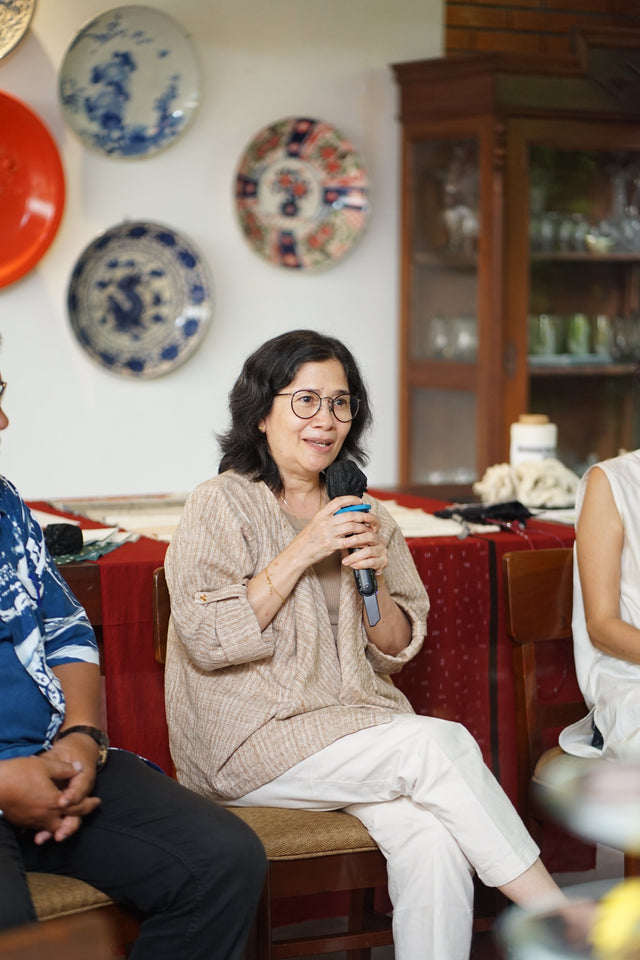
Sekar Kawung did not begin with cotton. It began with a question about land.
When Chandra Kirana Prijosusilo (Ibu Kiki) co-founded Sekar Kawung, the work was rooted in a simple conviction: that biodiversity and village culture could form the foundation of genuine economic wellbeing in rural communities. Textiles came later, almost sideways. She and a colleague started in two places with almost nothing in common, Sungai Utik in West Kalimantan, where the landscape is rainforest and permanently damp, and East Sumba, dry savanna and open fields. Different soils, different traditions, different problems to solve.
What both places had in common was weaving.
Cloth, she noticed, carried something that other products could not as easily carry. It held color that came directly from the landscape around it. The natural dyes in Sungai Utik and the dyes in East Sumba looked nothing alike, because the plants they came from grew in entirely different conditions. A textile made in a place could tell the story of that place in ways that were difficult to replicate elsewhere. It could also travel. And it could bring income back to the people who made it without requiring those people to leave.
Finding Tuban
The path to Tuban came through a material gap. In both Sungai Utik and East Sumba, the weavers were working with imported yarn, and in some cases with synthetic fiber. Cotton that arrived from elsewhere, dye that arrived from elsewhere. The circle was open at both ends.

Sekar Kawung began searching for a place where cotton itself was still grown locally. That search led to Tuban, on the north coast of East Java, where the port had been exporting cotton to China since the tenth century. The fiber had been here for so long that it had adapted completely to the place, becoming something the land itself produced without coaxing. Kapas lawa, the naturally brown variety grown by farmers in the Kerek district, requires no irrigation. It asks for no dye. The color it carries is the color of the soil and the heat that shaped it over centuries.
By industrial standards, the fiber is considered difficult. The staple is short. The yield per plant is low. But those limitations look different when you stop measuring against industrial expectations. "Instead of reflecting a failure to meet industrial expectations," Ibu Kiki explains, "kapas lawa points toward another set of priorities entirely, shaped by ecological conditions, material sensitivity, and long-term relationships with the land."
The Bottleneck
Arriving in Tuban, Sekar Kawung found a practice still alive but barely moving. The older women were weaving. The younger generation saw no income in it. The knowledge was present. The land was present. What had broken was the system connecting them.
The slowest parts of the process were separating the seeds from the fiber and spinning the yarn by hand. Both steps were so time-consuming that the economics never worked for anyone who needed to earn a living. The solution Sekar Kawung pursued was deliberate and narrow: introduce machines for precisely those two bottlenecks, and leave everything else as it was. Sejauh Mata Memandang contributed a ginning machine in 2024, which changed what was possible without changing the nature of the work downstream.

"The machine changed the pace of what was possible," Ibu Kiki says, "but change never happened overnight." Almost a year passed after the machine arrived before the community began to understand what it meant that their own cotton could become fine cloth for their own batik. Young batik entrepreneurs began seeking training in floor loom weaving. That shift, slow and practical, is what regeneration actually looks like in practice.
Risk and Roots

When Sekar Kawung introduced a larger cultivation plot of 3,500 square meters, they planted cotton alongside the farmers' existing crops of mung beans and maize rather than in place of them. The reasoning was direct. If the cotton fails, the farmers still have something. Risk should not fall entirely on the party least able to absorb it.
This is also, quietly, an argument against monoculture. Cotton grown in small quantities along field borders, the way it has always been grown in Tuban, is not a system that can be industrialized. It is a system that belongs to a specific place and survives because it has always been treated that way. Farmers tend a handful of plants the way you might tend a garden, picking a little each day across the season rather than harvesting in a single operation.
The work of Sekar Kawung over the past decade has been to keep that practice viable, not through preservation in amber, but through careful adaptation that extends what is already there.

"The roots are still there," Ibu Kiki says.
That sentence holds the shape of everything Sekar Kawung does. Not revival, not rescue. Continued tending of something that survived because the land and the people who know it never entirely let go.



0 Comments
There are no comments for this article. Be the first one to leave a message!