
Learning from Varanasi: Textiles as Living Heritage
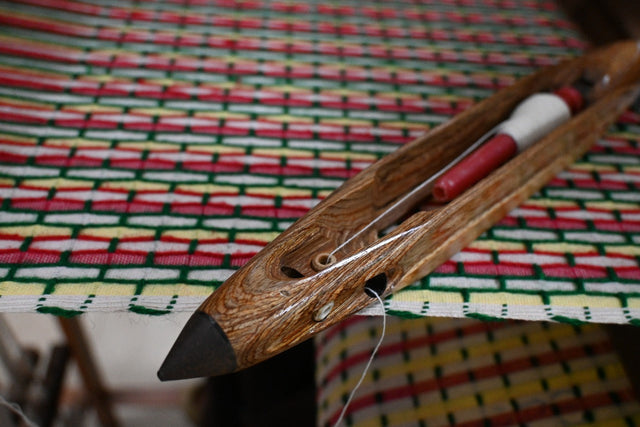
There are cities that hold their knowledge differently. Varanasi is one of them. Known also as Kashi or Banaras, it is among the oldest continuously inhabited cities in the world, a place where the sacred and the everyday have long existed in the same breath. The ghats along the Ganges carry the rhythm of daily ritual. The narrow lanes behind them have been home to silk weavers for centuries. To arrive here as someone who works with textiles is to arrive somewhere that takes the craft seriously, on its own terms, and in its own time.

In August 2025, Fadhilla Wandita represented Sejauh Mata Memandang at the International Certificate Programme on Heritage and Indigenous Textiles, held at the Indian Institute of Handloom Technology in Varanasi. The programme was organised by the Office of Development Commissioner (Handlooms) under India's Ministry of Textiles, in collaboration with the Ministry of External Affairs through the Indian Technical and Economic Cooperation Programme (ITEC). It brought together 26 participants from 16 countries, and marked the first collaboration between the two ministries in delivering an international programme of this kind.
In her opening address, Dr. M. Beena offered a framing that stayed with us: to study Indian textiles is to study a living cultural heritage, because every weave carries a story and an identity within it. That idea is not unfamiliar to us at Sejauh Mata Memandang. It is something we have always believed about Indonesian textiles too. But hearing it said in Varanasi, surrounded by a community that has organised its entire way of life around the loom, gave it a different weight.
Two Traditions, One Thread

The connection between India and Indonesia is not new. It stretches back more than two millennia, built through cultural exchange, spiritual journeys, and the quiet movement of knowledge across the sea. What the programme made visible is how much of that shared history lives inside the textiles themselves.
In India, the handloom sector is the second largest source of employment in the country. Weaving is not a niche practice or a heritage project; it is the economic backbone of entire communities. Visiting weaving clusters in Varanasi, spending time in spaces where Banarasi silk is made, and seeing how local knowledge is passed down through family and institution alike brought into focus something we recognise from our own work with Keluarga Sejauh: that craft endures not through preservation alone, but through use, through teaching, and through the relationships that form around the loom.

Both traditions understand that a piece of cloth holds more than its fiber. It holds the memory of who made it, the conditions in which it was made, and the values of the community that shaped it. Textiles, in this sense, are a shared language between our two countries.
What We Brought Home

For Sejauh Mata Memandang, the two weeks in Varanasi offered something that is difficult to find in any other way: direct encounter with a textile culture that has held its ground across centuries of change. The programme was designed for practitioners from across the Global South, and its underlying conviction was that development in the textile sector is most meaningful when it grows from within communities, not from outside them.
This resonates with how we try to work. Our circularity practice, our relationships with artisans and farmers, our commitment to knowing where every material comes from and who touched it along the way, these are not add-ons to the work. They are the work. Varanasi reminded us that this way of thinking has deep roots, and that we are part of a much longer conversation.

Innovation, we were reminded, does not require turning away from what came before. It grows from the ability to read the past carefully and carry it forward with honesty. That is as true in Varanasi as it is in Pekalongan, in Wonosobo, in Tuban.
We are grateful to have been part of this programme, and to return with new questions, new perspectives, and a renewed sense of what it means to work in textiles with care.



0 Comments
There are no comments for this article. Be the first one to leave a message!