
The Story Carried in Our Pouches
There is a moment in every learning process when the question changes. For us, it happened quietly, not with a single decision but through a gradual accumulation of questions.

When Sejauh Mata Memandang began, we chose paper packaging. It felt like the more responsible direction, familiar and honest. But the more we learned about where paper actually comes from, the less comfortable we became. Paper depends on trees. And not all trees are equal in what their loss costs the earth.
Through our conservation work in the Leuser Ecosystem and through guidance from Canopy, an organization that advocates for the protection of ancient and endangered forests, we came to understand how directly paper sourcing connects to biodiversity. Canopy helped us see that even well-intentioned paper use can contribute to the destruction of forests that have taken centuries to form. From that point, we committed to ensuring that any paper we use comes from responsible sources that do not threaten critical forest ecosystems. This became our Canopy Policy, and it remains one of the foundations of how we think about materials.
But the policy also forced a deeper question: If responsible paper is still paper, and paper still carries a footprint, what were we really solving?
Beyond the Material

We explored cassava-based bags next, drawn by the promise of something plant-derived and biodegradable. The material felt hopeful. Then research revealed a different challenge. Biodegradable packaging requires specific conditions to break down properly and does not easily enter standard recycling streams. More than that, it can reinforce a culture of disposability: the material changes, but the relationship to discarding stays exactly the same.
This was the moment that reshaped our thinking. The question was no longer only about finding a better material. It was about what we understood consumption to mean.
From the Production Floor

Around the same time, we began paying closer attention to what was accumulating on our production floor. Cotton offcuts, the small remnants left behind after cutting, were building up steadily. They were clean, usable, and on their way to becoming waste.
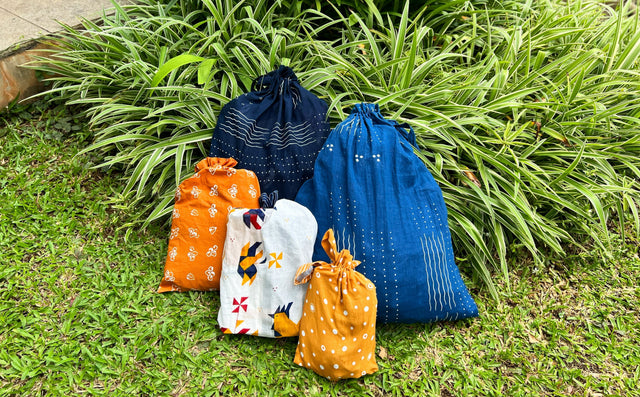
The answer had been quietly present all along. We began transforming these offcuts into reusable fabric pouches. No new material needed to be sourced. No additional resource extracted. What the production process left behind became the thing we hand to our Sahabat Sejauh when they take something home.
Circularity, in this case, was not a concept we applied from the outside. It emerged from looking honestly at what we already had.
Objects That Stay

For special editions, we turned to tin. The choice was rooted in something cultural: tins are containers that people in Indonesia tend to keep. They migrate from shelf to drawer to dressing table, holding thread, buttons, small keepsakes. Packaging that behaves this way does not need to be disposed of because it has already found a new role.
Both the pouch and the tin carry the same intention. They are designed to remain useful beyond their first purpose, to live alongside their owner rather than be left behind.
A Responsibility That Belongs to Everyone

Our founder and Creative Director, Chitra Subyakto, often returns to a simple belief: every action carries consequences, and sitting with that honestly is where the work begins. It means listening to Keluarga Sejauh, learning from inherited practices, and keeping our partnerships with organizations like Canopy, Sekar Kawung, and EcoTouch alive and reciprocal.
Sejauh Mata Memandang does not claim to have resolved the challenges of the textile industry. What we do believe is that packaging is never a neutral decision. Every pouch that replaces a paper bag, every tin that becomes a household object, every offcut that finds a second life is a quiet demonstration of a different relationship between making and discarding.
That relationship cannot be sustained by producers alone. It asks something of everyone who touches the object, from the hands that sew it to the hands that receive it. Responsibility travels the same path the garment does.
Every day is Earth Day.



0 Comments
There are no comments for this article. Be the first one to leave a message!