
Studio Sejauh: Cloth, Color, and Trust, A Dialogue with Mugi Batik | Sejauh Mata Memandang
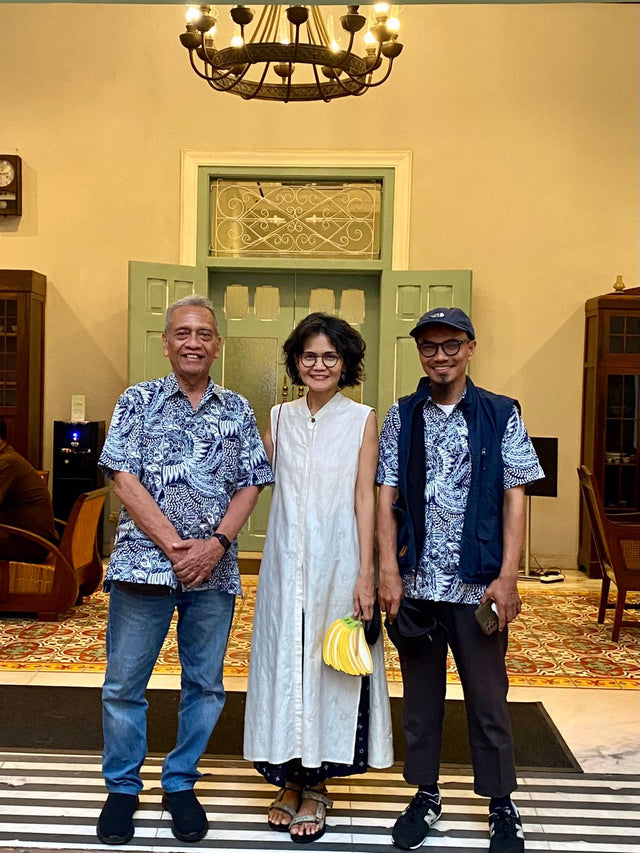
Pekalongan sits on the north coast of Central Java, southwest of Semarang, and has long been one of the most important centers of batik on the island. It is a city where the craft is not preserved behind glass but practiced daily, passed between generations, and still visible in the hands of people who have been doing it for most of their lives. In the middle of the shift toward digital print and faster production methods, batik tulis continues here, held in place by workshops like Mugi Batik.
Pak Mugi Raharjo founded Mugi Batik in Jakarta in 2010. Five years later, he returned to Pekalongan. For him, it was a natural decision. The rhythm of the city, the knowledge embedded in its artisan community, the way craft and daily life move together here: these things had always shaped how Mugi Batik worked, even when the studio was elsewhere. Pekalongan was where it belonged.

Today, the workshop is run alongside Johan, Pak Mugi's son, who has grown into the work and carries it forward with the same attention his father brought to it. The majority of the people working in the studio are women, many of whom have been there since the beginning. Roles are distributed with care: drawing, waxing, dyeing, finishing. Each stage is handled by someone who knows it well.
Where We Began
Sejauh Mata Memandang has been working with Mugi Batik since 2014, making them one of our earliest artisan partners. The relationship has grown through many collections and evolved through different kinds of work, but the foundation has remained the same: an openness to learning from each other, and a shared commitment to making something that is honest about how it was made.

One of the most significant collaborations was the Republik Sebelah Mata collection, shown at Jakarta Fashion Week 2025, where Sejauh Mata Memandang worked with renowned Indonesian contemporary artist Eko Nugroho and visual designer Felix Tjahyadi to voice concerns about social and political issues in Indonesia. Mugi Batik contributed hand-drawn batik to the collection, translating Eko's experimental illustrations into cloth. The motifs pushed beyond the conventions of batik tulis into something more charged and deliberate. Mugi Batik carried it with the care and precision the work demanded.
What the Cloth Asks

"Sejauh's motifs often look simple at first," says Johan. "But when you begin to translate them onto cloth, you feel the complexity." Lines that read as light carry weight in practice. Compositions that appear uncomplicated require precision at every stage. It is one of the things that has made this collaboration a genuine exchange rather than a transaction.
Knowledge at Mugi Batik is not passed down through instruction manuals. It moves through proximity, through watching, through the slow accumulation of experience working alongside people who already know. New understanding arrives through the process itself, not before it.
The Color That Requires Patience

In the Puspa collection, Mugi Batik's role centered on dyeing with secang, the wood of Biancaea sappan, a plant native to Southeast Asia that produces warm tones ranging from pale pink to deep red-brown depending on how it is prepared and fixed.
Secang gives color readily, but it does not hold easily. It requires a mordant to fix the dye to the fiber, and even then, the process must be repeated. Each round of dyeing and drying builds the color slowly. The process depends on strong sunlight, which means it cannot always be completed in a single session. It is weather-dependent, time-dependent, and skill-dependent.
"The color it gives is soft," Johan notes, "but the process is not simple." What comes through in the finished cloth is not just the dye but the patience and attention of the people who worked with it.
A City That Feels the Climate
Pekalongan is also a city that is sinking. Research from Indonesia's National Research and Innovation Agency (BRIN) has identified the north coast of Central Java as one of the most affected areas in the country for land subsidence, with Pekalongan among the hardest hit. The loss of mangrove ecosystems along the coast has reduced the natural buffers against tidal flooding and erosion.
Around Mugi Batik, the effects are concrete and close. Flooding has increased in frequency and intensity. The artisans who work there live with the same water that sometimes enters their homes and disrupts their workspace. Batik tulis depends on sunlight for drying. When the weather shifts, the work shifts with it. There is no separation between the ecological situation of the city and the daily practice of the craft.
This is part of why circularity, for us, is not only a production principle. It is an orientation toward the places and people we work with. Pekalongan's situation is a reminder that the choices made at every stage of making: which materials, which processes, how long things last, are connected to land, to water, and to the lives of the people whose hands are in the cloth.
Still Learning Together

Twelve years of working with Mugi Batik has brought many collections, many materials, and many moments of figuring things out in real time. The introduction of plant-based dyes, collaborations with other artists, new techniques encountered along the way: each has added to what the studio knows and what we know together.
What stays constant is the willingness on both sides to keep asking questions. The craft practice at Mugi Batik is not fixed. It is held by people who are still curious about what it can do, and we find that, over ten years, is the thing we are most grateful for.
Every day is Earth Day.



0 Comments
There are no comments for this article. Be the first one to leave a message!