
Studio Sejauh: From the Ground Up, Growing with Rabersa
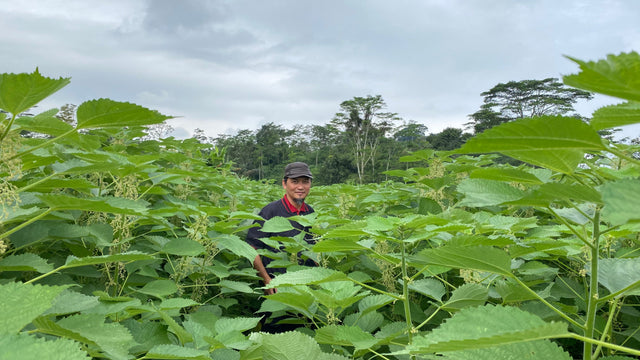
For us, textile sovereignty begins with a question: where does the fiber come from, who grew it, and what did its journey cost the earth? It is an effort to ensure that every step of making, from seed to seam, grows from local resources, is processed with care, and carried through with a full sense of responsibility toward people and the natural world.
Why Fiber Matters
Not all fibers ask the same things of the earth. Cotton, which covers only around 2.4 percent of the world's farmland, accounts for up to 16 percent of global insecticide use, more than any other major crop. It is thirsty, chemically dependent, and land-intensive in ways that accumulate quietly over time.
Hemp offers a different picture. It requires approximately 50 percent less water than cotton, saving roughly 1,300 liters of water per piece of clothing produced. On the same area of land, it can yield between 200 and 250 percent more fiber. It grows without heavy pesticide or insecticide use, naturally resistant to pests, and its dense, fast growth cycle suppresses weeds on its own.
These comparisons are not made to diminish cotton, which remains part of our own material practice, but to open the question of what is possible when we look more carefully at what the land can offer.
Ramie: A Fiber Rooted in Indonesian Soil

Among the natural fibers with the most promise for Indonesia, ramie stands apart. Known scientifically as Boehmeria nivea, it produces long, lustrous fibers with characteristics comparable to cotton, strong, breathable, and suited to our climate. It has deep roots in the agricultural landscape of this country, and with the right ecosystem around it, it could become a genuinely national fiber, grown by smallholder farmers across the archipelago.
A small fact about ramie: Ramie is one of the oldest fiber crops in the world, with records of its use in China dating back over 5,000 years. It is also naturally antibacterial, which means clothing made from ramie resists odor and stays fresher for longer between washes.

The first steps toward that potential are already underway. Rabersa, founded by Wibowo Akhmad in 1999 in Wonosobo, Central Java, plays a central role in processing ramie into natural fiber through semi-industrial methods. Despite still being in a development phase, the quality of their output, marketed under the name Inagrass, has reached a standard competitive in global markets.
Currently, around 95 percent of Inagrass fiber is directed toward export, primarily to the United States. International demand continues to grow, but production capacity remains constrained by the availability of machinery, capital, and land. This is the tension at the heart of the story: a fiber grown in Indonesian soil, processed by Indonesian hands, leaving Indonesian shores to become fabric elsewhere. It is a tension worth naming, and one that makes the case for building stronger local systems even more urgent.
A Fiber That Gives Back

What makes ramie compelling is not only what it produces but what it returns. Its leaves can be used as feed for goats and sheep. The organic matter from that process returns to the soil as fertilizer. Almost nothing is wasted. The economic value circulates within the rural ecosystem of Wonosobo itself, strengthening the livelihoods of the farmers who grow it.
This is what circular practice looks like when it begins at the source, not as a concept applied after the fact, but as a natural property of the plant and the system built around it.
Globally, demand for natural fiber is rising. Annual global demand for ramie is estimated at one million tons, and Indonesia has the potential to meet up to 20 percent of that need. That is not a small number. It points toward something larger than a single collaboration or a single crop: a vision of Indonesian textile production that is rooted in its own soil, accountable to its own communities, and honest about its relationship with the earth.
Walking This Together

We chose not to walk this path alone. Our collaboration with Rabersa is part of a wider commitment to building systems rather than simply sourcing materials. Farmers, fiber processors, artisans, and partners all sit within the same space of learning and exchange. Development here does not stop at production. It grows as a shared movement toward something more whole.
Every piece of clothing we make is an attempt to honor that. We are still learning, still evaluating, still finding better ways. But the direction is clear: clothing that begins in the earth, returns to it, and carries the story of every hand involved honestly and openly.
Every day is Earth Day.



0 Comments
There are no comments for this article. Be the first one to leave a message!