
Studio Sejauh: Closing the Loop, with EcoTouch
The first thing EcoTouch learned about textile waste is that it takes up space.
Not in an abstract sense. Literally. Eleven tons of donated clothing, sorted from Sejauh Mata Memandang's collection programs over several years, fills a room six meters wide, six meters long, and three meters high. That is the image Christina Harjanto (Co-Founder of EcoTouch) returns to when she describes the moment this partnership began. Her team had expected perhaps a single ton. They were not prepared for what arrived from Sejauh’s warehouse in Kemang, South Jakarta, loaded onto trucks and brought down to their facility in Bandung.

"We were a bit shocked," she says, understating it considerably. "We had to figure out what we were actually dealing with."
What they were dealing with was the physical reality of what it means to take clothing seriously at the end of its life.
Where It Began
EcoTouch did not begin as a fashion story. It began with a father watching factory waste burn.
PT Superbtex, the Bandung manufacturing company behind EcoTouch, has been working on textile waste R&D since 2013. The founder, Heidy Loe, spent years attending industry exhibitions in Europe, where recycling machinery for textiles already existed. Back in Bandung, surrounded by garment factories whose off-cuts and discards went straight to landfill or incinerator, he saw the gap clearly. The waste was enormous. The solutions were absent. Something had to be built.
The product that emerged from that early research was insulation. Not clothing, not yarn, but building insulation made from textile fiber. The reasoning was direct: insulation absorbs material in volume, which means it can actually make a dent in the scale of the problem. It is also something Indonesia genuinely needs. Houses built without insulation in a tropical climate sit hot and loud under their roofs. The demand was there. What was missing was education.
EcoTouch as a public-facing brand came later, in 2020, when the pandemic pushed the company from B2B manufacturing toward direct consumer engagement. People stuck at home for the first time noticed what their homes actually felt like. Hot. Noisy. The conversation about insulation had an opening it had never had before.
The name EcoTouch came from texture. Mineral wool and glass fiber insulation, the industry standards, are unpleasant to handle and potentially harmful to inhale. EcoTouch insulation, made from recycled textile fiber, can be held with bare hands. That fact became the name.
The Eleven Tons
The partnership with Sejauh Mata Memandang started from a distance. EcoTouch had been watching Sejauh's donation collection programs from the outside, curious about the volumes and the quality of material coming in. They reached out through Instagram. The timing was not right at first. They kept trying.

When Chitra Subyakto finally visited the Bandung facility and saw how the process worked, something clicked. She had already been separating wearable from non-wearable donations, setting the latter aside. The non-wearable pile had been accumulating in a warehouse. EcoTouch asked how much there was.
Eleven tons.
The team loaded it all and brought it to Bandung. What followed was an education in the genuine complexity of recycling mixed textile waste. Of the eleven tons, only around forty percent could be processed. The rest came back to Jakarta. The barriers were not technical in any simple sense. They were material. Clothing donated by the public arrives in every condition imaginable: wet, moldy, mixed fiber, synthetic-heavy, studded with buttons and zippers and sequins that have to be removed by hand. A single pair of jeans can take considerable time to unpick fully. At scale, across tonnes of clothing, that labor is what makes the economics of textile recycling so difficult to sustain.

No waste management partner EcoTouch approached during the pandemic was willing to take it on. After a year of searching, they built their own waste management operation rather than wait for one to exist.
From Scrap to Thread

Since September 2021, EcoTouch has received 36,210 kilograms of donated clothing through its partnership with Sejauh Mata Memandang. Of that, 23,815 kilograms have been processed into recycled material. A further 12,216 kilograms proved too degraded or compositionally unsuitable to recycle, and 178 kilograms was residue: buttons, elastic, zippers, separated during sorting.
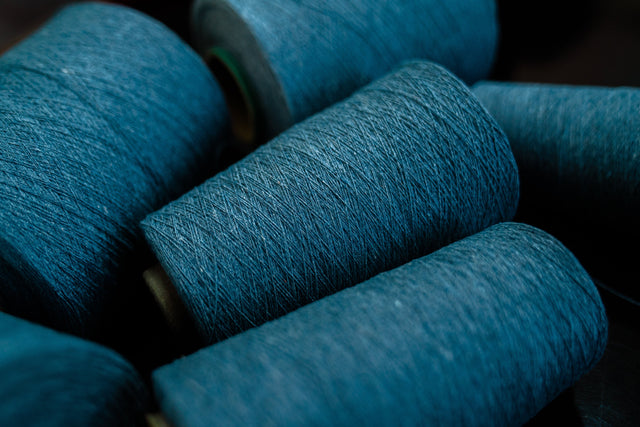
The recycled yarn that EcoTouch produces from this material is genuinely unusual. Seventy percent of its composition comes from reclaimed fiber. The remaining thirty percent is what the industry calls dropping cotton, cotton fiber that falls during transport and handling, collected and used as a strengthening agent. Without it, the short recycled fibers would break too easily under tension.

Because the fiber comes from mixed waste, the yarn carries the natural color of everything it contains. No bleaching. No overdyeing. The color is the color of the waste itself, a warm, uneven grey-brown that shifts slightly batch to batch. "If we bleach it white and then redye it," she explains, "we have just added another chemical process to something that was supposed to reduce harm. That would answer the wrong question."
The yarn can currently be produced only in heavier weights, a limitation of the short fiber length. This means it cannot be woven on industrial power looms. It requires ATBM, the handloom. That constraint, which might look like a disadvantage, is what brought EcoTouch and Sejauh's artisan network into the same circle.

The Moment at Jakarta Fashion Week
When Sejauh agreed to try weaving EcoTouch's recycled yarn into cloth for the Tarum collection in 2023, it was the first time the yarn had ever been made into fabric. The EcoTouch team came to Jakarta Fashion Week to see it.

"When it was still yarn, it felt like dough that hadn't been baked yet," Christina says. "When we saw it become cloth, become clothing, and Mbak Chitra presented it with such pride, saying this came from recycled material, we were moved. Really moved. I still get goosebumps thinking about it."
The Tarum collection used recycled jacquard woven from EcoTouch yarn. The dyeing process ran fourteen rounds using natural plant dyes, each round using a limited quantity of water that was reused until it was exhausted. Today, 2.5 percent of Sejauh Mata Memandang's 1,029 active products are made with EcoTouch recycled thread. That number is small. It is also, given the constraints of the yarn's weight and weave requirements, a serious achievement.
What the Waste Is Teaching
One of the less expected outcomes of this work has been what it reveals about the clothing that arrives. EcoTouch has noticed over time that donations coming through Sejauh's network require significantly less sorting than material from other sources. The community that forms around a label with a clear circular practice seems, gradually, to internalize what that practice actually needs. Less polyester. Cleaner sorting. More natural fiber.
"The education is working," she says. "We can see it in what arrives."
That education runs in both directions. EcoTouch wants people to understand what textile recycling actually involves, not as an abstract environmental argument but as a physical, laborious, expensive process. Clothing that arrives wet needs washing and drying before it can be sorted. Clothing with rivets needs to have them removed one by one. The sequins on a single blouse can add significant time to what should be a straightforward step. The cost of processing textile waste is, she says, tens of times higher than the raw material value of what comes out.
This is not an argument against recycling. It is an argument for understanding what recycling is. A garment that arrives clean, made from natural fiber, with minimal hardware, is a different material proposition than one that arrives otherwise. Every choice made upstream, in design, in sourcing, in the way a label communicates with the people who wear its clothing, lands eventually in the sorting room.

"Waste, at some point, will be the resource," she says. "There will not be another option. We want to be ready when that moment comes, not starting late."
The insulation panels on the ceiling of a café in Kemang. The indigo warp of a Tarum jacket woven on a handloom in Pekalongan. Eleven tons, arriving by truck from a warehouse in South Jakarta, sorting itself slowly into what can be saved and what still cannot. The circle is not clean. It is careful, costly, and continuing.



0 Comments
There are no comments for this article. Be the first one to leave a message!