
Studio Sejauh: Pages and Cloth, In Step with Vitarlenology
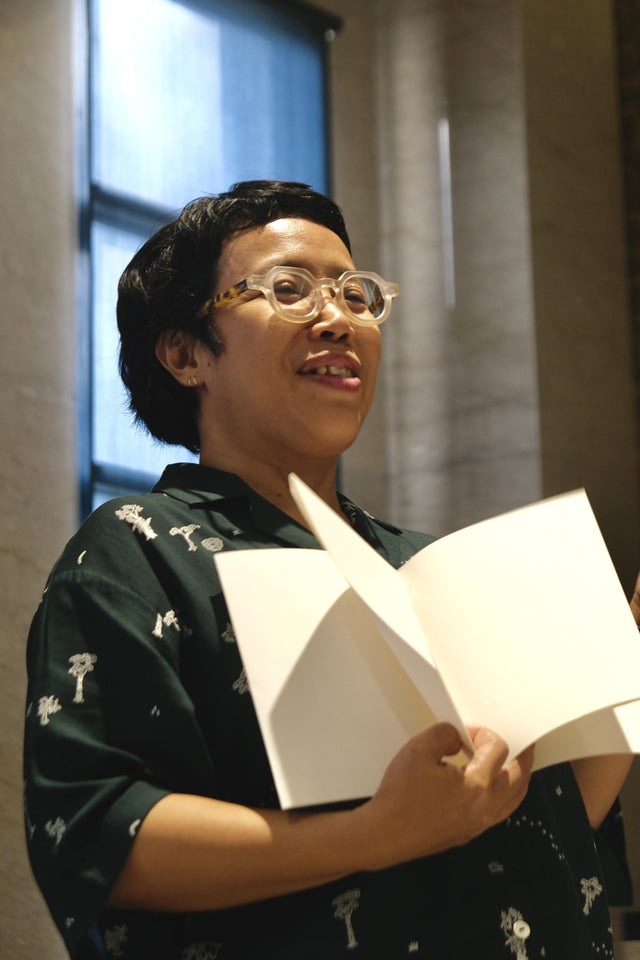
There is a kind of knowledge that does not live in books. It lives in the hands that have repeated a gesture long enough to understand it from the inside: the weaver who reads tension in a thread, the bookbinder who knows by touch when a spine is ready. Before knowledge was written down and organized into pages, it moved through practice, through repetition, through the slow accumulation of attention paid to material and process.
Tarlen Handayani has built her life around this understanding. A bookbinder, book artist, founder of the literacy and craftivism space Tobucil & Klabs in Bandung, and currently a graduate student in Anthropology at Universitas Gadjah Mada, she came to bookbinding not through a formal path but through the quiet habit of making her own journals. What began as something personal gradually became a practice, and the practice gradually became a vocation.
Learning by Hand

Tarlen's first bookbinding class was in 2008 at Etsy Lab in Brooklyn, New York, where she was spending time on a fellowship from the Asia Cultural Council. She had gone to observe arts community development in New York City. She came back with something she had not expected: a craft that would shape the next decade of her life.
She taught herself further, opening classes across cities in Indonesia from 2012 onward. In 2018, she deepened her practice at the Canadian Bookbinder and Book Artist Guild in Toronto, eventually joining as a member and teaching bookbinding at the University of Toronto's Ethnography Lab. The label Vitarlenology grew from this journey, carrying her notebooks and her teaching into the world.

What Tarlen describes as the heart of bookbinding is also what makes it resonate with how we work at Studio Sejauh. "Bookbinding teaches us to care for what we have," she has said, "and to feel a sense of enough." It is a slow practice, one where each step is deliberate and connected to the one before it. Sheets are gathered, folded, sewn, and bound in a sequence that cannot be rushed without consequence. The book that results carries the memory of that process in its spine.
Where Cloth Meets Page

The collaboration between Vitarlenology and Studio Sejauh began from a simple observation: the production floor leaves behind offcuts. Small pieces of fabric, clean and usable, accumulate at the edges of every collection. Rather than letting them become waste, we began asking what else they could become.

The answer arrived in the form of a patchwork notebook. These notebooks are part of DAUR, our ongoing effort to reduce textile waste by giving leftover material a second life. Together with Tarlen, we have developed three products from this process: the DAUR Notebook, the DAUR Journal, and the Cardholder Wallet. Each is made from textile offcuts, stitched into a surface that is different every time. No two pieces are the same. The variation is not a limitation of the process but its most honest quality: it tells you exactly where the material came from and how it was handled. The process is open from beginning to end, from the selection of offcuts on the production floor to the finished object in someone's hands. Every step is traceable, every decision intentional.
A Shared Sense of Enough

There is something in both bookbinding and cloth practice that resists the logic of more. A well-bound book is made to last. A well-made piece of clothing, cared for properly, outlives the season it was made for. Both ask the same thing of the person who holds them: pay attention, move slowly, and treat the object as something worth keeping.
For Tarlen, this is not a philosophy she arrived at through theory. It grew from years of working with her hands, of understanding material through touch, and of building a practice around the belief that craft is a form of service, a way of offering skill and care to the people who will receive what you make.
For Studio Sejauh, it is the same. Circularity is not a method we apply to the work. It is the disposition from which the work begins. When cloth offcuts become notebook covers, nothing is lost. The material simply continues its life in a different form, carried forward by hands that knew how to receive it.
Every day is Earth Day.



0 Comments
There are no comments for this article. Be the first one to leave a message!