
Ramie: Indonesia's Oldest Fiber and What It Carries
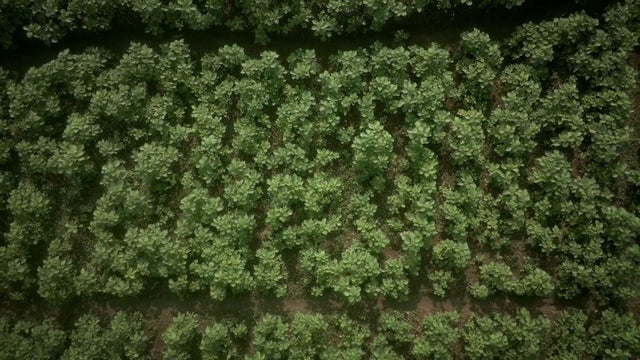

The word ramie comes from rami, a Malay word. The plant, known scientifically as Boehmeria nivea, is native to eastern Asia and has been part of the material life of this region for thousands of years, long before the global textile trade introduced cotton as its dominant fiber.
Ramie is one of the oldest fiber crops in the world, with evidence of use stretching back at least 6,000 years. It was used in ancient China before cotton arrived in Asia, appearing in burial shrouds and everyday cloth alike. It traveled along trade routes and appears in Sanskrit literature, including the Ramayana. In Egypt, its resistance to bacteria and mildew made it a material for wrapping mummies as far back as 5000 BC. Across the Indonesian archipelago, ramie appeared in ceremonial textiles from Sumatra, woven alongside silk and gilt metal thread for ritual use.
This is not a forgotten material from somewhere else. It is a fiber with roots in this soil, carrying a history that belongs here.
A Fiber That Was Set Aside
The global dominance of cotton is relatively recent. In China, ramie was one of the primary textile fibers until cotton began arriving around AD 1300. Across much of Southeast Asia, local fibers including ramie gradually receded as trade systems shifted toward crops that were easier to standardize, mechanize, and move at scale. This was not a reflection of quality. It was a reflection of which materials fit more easily into the logic of industrial production.
Cotton's rise came with costs that accumulated quietly: intensive water use, heavy reliance on pesticides and insecticides, and soil demands that compound over time. Ramie grows differently. It thrives in warm, humid climates. It can be harvested multiple times a year. It requires relatively low chemical input, and its leaves return nutrients to the soil as feed and fertilizer. It does not exhaust what it grows in.
The fiber itself is among the strongest natural fibers known. It becomes stronger when wet, making it well-suited to Indonesia's tropical climate. It has a natural sheen and breathability that make it comfortable to wear. And yet it has largely stepped back from contemporary production systems.
The Patience It Asks For

Part of the reason ramie stepped back from mainstream production is also what makes it worth returning to: it asks for more time and attention than industrial systems typically allow. Processing ramie is labor-intensive. The fiber must be carefully extracted from the stalk, degummed, and prepared before it can be spun into yarn. Spinning itself requires experienced hands because the fiber, while strong, has low elasticity.
In a production system that values speed and uniformity, this can feel like a limitation. A material that asks for patience and skill at every stage is a material that keeps knowledge alive. Working with ramie means engaging with a craft practice that cannot be fully automated, and that carries within it the understanding of many hands that have worked with it before.
Ramie in Wonosobo Today

At Sejauh Mata Memandang, we source ramie through CV. Rabersa in Wonosobo, Central Java, founded by Wibowo Akhmad in 1999. Rabersa processes ramie into fiber through semi-industrial methods, marketing it under the name Inagrass. The quality of their output is competitive internationally, with around 95 percent currently exported, primarily to the United States.
That figure points to a tension we think is worth naming: a fiber native to this region, grown and processed here, leaving Indonesian shores to become fabric elsewhere. Together with Rabersa, we are working to change that in a small but concrete way. We are developing ramie cultivation directly in Wonosobo, with a target of expanding the growing area to six hectares by the first quarter of 2025, supporting local farmers and building a supply of natural fiber that stays within the Indonesian textile system.
This is a gradual process. It will not resolve overnight. But it is the direction we are committed to: a fiber that begins here, is processed here, and becomes cloth here.
What the Plant Gives Back

Ramie is a nitrogen-fixing plant. Its roots draw nitrogen from the air and deposit it into the soil, which means growing ramie improves the land rather than depleting it. Its leaves can be used as animal feed, and what remains returns to the soil as organic fertilizer. Almost nothing is wasted.
This circular quality is not something we have engineered into the material. It is already there, in the biology of the plant itself. A fiber that has been part of this landscape for thousands of years has had time to find its place within the ecology it belongs to.
Why We Keep Coming Back to It

Choosing ramie is not a nostalgic gesture. It is a practical one, grounded in what we know about this fiber's properties, its relationship to the land, and its potential within a more responsible production system.
There is also something in its history worth holding onto. Ramie was here before cotton arrived. It was woven into ceremonial cloth, traded across islands, mentioned in ancient texts. It is a fiber that belongs to this part of the world. Reintroducing it into contemporary practice is not about revival for its own sake. It is about asking whether the fibers we reach for today are the ones that make the most sense for where we are, what grows here, and who knows how to work with it.
We think ramie does.
Every day is Earth Day.



0 Comments
There are no comments for this article. Be the first one to leave a message!